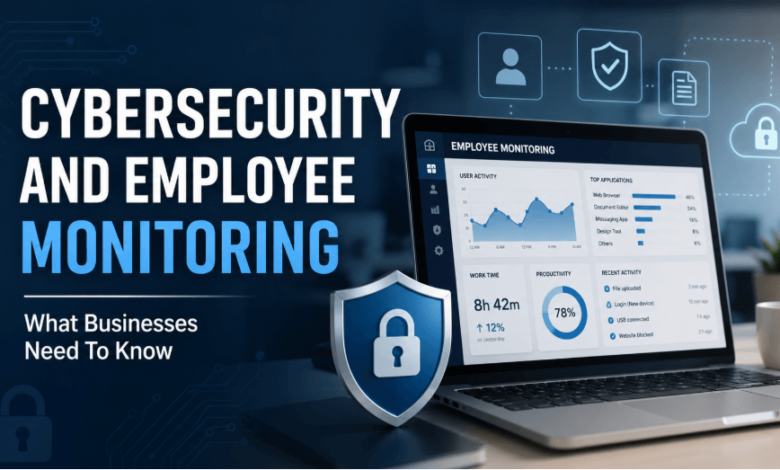
Most conversations about cybersecurity focus on the threats coming from outside: hackers, phishing campaigns, ransomware, and nation-state actors. Those threats are real and serious. But some of the most costly breaches in recent years didn’t come through a firewall; they walked in through the front door.
As remote and hybrid work became permanent fixtures of modern business, the perimeter that security teams once defended dissolved. Employees now work from home networks, personal devices, coffee shops, and co-working spaces. The attack surface expanded dramatically, and the risk from insider threats, whether malicious or simply careless, grew with it.
That’s where employee monitoring software entered the cybersecurity conversation. What started as a productivity tool has become a meaningful layer of enterprise security, giving businesses visibility into the activity patterns that precede most data breaches. Understanding how it works, what it protects against, and where the ethical lines sit is increasingly important for any organization serious about security in 2026.
What Is Employee Monitoring?
From Timesheets to AI-Powered Platforms
Employee monitoring, in the modern sense, means using software to observe and record how employees interact with company systems during working hours. The old version involved badge scanners and paper timesheets. Today’s workforce monitoring tools are unrecognizable by comparison: they track application usage, website visits, login patterns, file transfers, and in many cases, the content of what’s on screen.
Cloud-based employee monitoring software took this further by making that data available in real time, from anywhere, through centralized dashboards. What began as a remote workforce management tool is now one of the more powerful instruments in a security team’s kit.
Why Businesses Use It
Productivity tracking is the most obvious driver, but it’s far from the only one. Cybersecurity protection, compliance requirements, and regulatory audit trails are now among the top reasons organizations invest in monitoring tools. In industries like finance, healthcare, and legal services, where data handling is tightly regulated, monitoring software isn’t optional. It’s how companies demonstrate that their controls actually work.
How Employee Monitoring Software Supports Cybersecurity
Detecting Insider Threats
Insider threat detection is arguably the most compelling security use case for employee monitoring. The challenge with insiders is that they already have access; the normal controls that stop external attackers don’t apply. What does reveal suspicious behavior is an anomaly: someone accessing files they’ve never touched before, logging in at 2 a.m., downloading an unusual volume of data to an external drive.
Modern monitoring software is built to catch exactly these patterns. Behavioral analytics establishes a baseline for each user and flags deviations automatically. That doesn’t mean every deviation is malicious; context still matters, but it creates a structured early-warning system that pure perimeter security can’t replicate.
Preventing Data Breaches and Strengthening Endpoint Security
Data loss prevention is another area where monitoring software earns its place. Tracking file transfers, monitoring what gets sent to external services, and flagging large exports of sensitive data are all capabilities that modern platforms offer. When someone is about to move a client database to a personal Google Drive, monitoring software can catch that in real time rather than during a post-breach investigation.
Remote device monitoring matters for endpoint security, too. When employees work outside the office, their devices become endpoints that are harder to control. Activity monitoring combined with browser and application tracking gives security teams visibility into what’s happening on those machines, and alerts them when something doesn’t look right.
Compliance and Security Auditing
Regulatory compliance is increasingly tied to demonstrable controls, and monitoring software generates the audit trails that prove those controls exist. Whether it’s HIPAA, SOC 2, PCI-DSS, or any number of regional data protection frameworks, auditors want evidence that someone is watching and that anomalies get investigated. Monitoring platforms build that evidence automatically.
Cybersecurity Risks Businesses Face Without Employee Monitoring
Insider Threats and Remote Work Vulnerabilities
Without visibility into employee activity, malicious insiders can operate undetected for months. The average time to detect an insider breach is alarmingly long , often well over a hundred days, precisely because most organizations lack the behavioral telemetry to catch it early. Negligent employees present a different but equally serious risk: clicking phishing links, using weak passwords, connecting to unsecured home networks, or installing unauthorized software that introduces new attack vectors.
Shadow IT, employees using tools and services that haven’t been approved or reviewed by the security team, is a chronic problem in remote work environments. Without monitoring, these tools remain invisible to the organization until something goes wrong.
Credential Theft and Data Leakage
Compromised accounts are among the most common entry points for breaches, and they’re particularly hard to detect without behavioral baselines. If an attacker uses stolen credentials to log in, they look like a legitimate user, unless their behavior diverges from the established pattern. Monitoring software provides the context that makes that divergence detectable.
AI-Powered Employee Monitoring in 2026
From Reactive to Predictive Security
Artificial intelligence transformed employee monitoring from a recording tool into an anticipatory one. AI-powered threat detection doesn’t just document what happened after the fact; it identifies risk signals before a breach occurs. Predictive threat intelligence analyzes behavioral patterns across an entire organization to spot the precursors that tend to precede incidents: escalating access requests, unusual hours, declining engagement, and increased data access.
Real-time alerts and automated responses mean that security teams can act within minutes rather than discovering the problem weeks later. Smart workforce analytics have also improved the accuracy of these systems significantly, reducing false positives that used to make earlier monitoring tools impractical to act on.
See also: How to find the Best Business Software and Services for Finance & Accounting
Employee Privacy Concerns and Legal Compliance
Is Employee Monitoring Legal?
The short answer is yes, in most jurisdictions, but with meaningful caveats. Workplace monitoring laws vary significantly by country and even by state or province. Many require explicit notice to employees before monitoring begins. Some prohibit specific forms of tracking, such as keystroke logging or webcam monitoring, without additional consent. Organizations operating across multiple countries need to navigate a patchwork of requirements that is still evolving.
GDPR, CCPA, and the Ethics of Monitoring Data
GDPR in Europe and CCPA in California represent the most stringent frameworks currently in force, and both impose real obligations on how monitoring data is collected, stored, and used. The principle of data minimization, collecting only what is genuinely necessary for a stated purpose, applies directly to workplace monitoring. Collecting keystroke data to detect insider threats is a different proposition than collecting it to measure how fast someone types, and regulators increasingly expect organizations to make that distinction explicitly.
Balancing Cybersecurity and Employee Trust
Transparency is the single most important factor in whether monitoring software builds or destroys workplace trust. Employees who know what’s being tracked, why it’s being tracked, and who can access that data are far more accepting of monitoring than employees who discover it by accident. Framing monitoring as a security tool rather than a surveillance mechanism, and backing that up with policies that actually limit how the data is used, makes a meaningful difference.
Best Practices for Ethical Employee Monitoring
Transparency, Minimization, and Security
Start with a clear, written monitoring policy that employees read and acknowledge before monitoring begins. Be specific about what is captured, how long it is retained, who can access it, and what triggers a review. Vague policies create distrust even when the monitoring itself is reasonable.
Collect the minimum data necessary for your stated purpose. If the goal is insider threat detection, you don’t need screenshots every three minutes; you need behavioral anomaly alerts. If the goal is compliance auditing, you need access logs, not keystroke records. Data minimization isn’t just a legal requirement; it also reduces your own liability if the monitoring data is ever breached.
Finally, protect the monitoring data itself with the same rigor you apply to other sensitive company information. Access should be role-based and logged. The irony of monitoring software that isn’t itself secured is not lost on the regulators who audit these systems.
Challenges of Employee Monitoring Technology
Employee resistance is the most common friction point, and it’s often proportional to how monitoring is introduced rather than what it actually does. Organizations that roll out surveillance-style tools without clear communication tend to see morale drop and turnover spike.
Over-monitoring creates its own problems. When employees feel watched at every moment, they develop anxiety rather than accountability, and often spend energy managing the metrics rather than doing meaningful work. Misinterpreting productivity data is a related risk: a low activity score on a given afternoon might mean someone is thinking hard about a complex problem, not that they’re not working.
The monitoring data itself is also a potential liability. A database full of behavioral profiles, screenshots, and keystroke records is an attractive target. Organizations that collect this data need to treat its protection as seriously as any other sensitive asset.
Future Trends in Employee Monitoring Software
Privacy-first monitoring is the direction the industry is heading, driven by both regulation and employee expectations. Rather than building detailed profiles of individual behavior, the next generation of platforms will focus on aggregate patterns and anomaly detection, surfacing risk without building a dossier on every person in the organization.
Zero-trust security models are increasingly integrated with monitoring software, treating every access request as a potential threat regardless of whether it comes from inside or outside the network. Combined with smarter behavioral analytics and AI-driven workforce intelligence, this creates a security posture that is simultaneously more capable and less intrusive than what came before.
The future of remote workforce monitoring isn’t more data, it’s a smarter interpretation of less data, in the service of genuine security rather than surveillance for its own sake.
Conclusion
Cybersecurity and employee monitoring are now deeply intertwined, and that relationship is only going to deepen as work continues to be distributed across locations, devices, and time zones. The businesses that get this right treat monitoring software as a security tool first, one that helps them detect real threats, maintain compliance, and protect sensitive data, rather than as a mechanism for watching employees.
The ethical foundation matters as much as the technology. Transparent policies, genuine data minimization, and respect for employee privacy aren’t just legal requirements in most jurisdictions; they’re what make monitoring sustainable in organizations where trust is still worth something.
In 2026, the question isn’t whether to monitor. For most businesses, some level of workforce monitoring is simply part of responsible security practice. The question is whether to do it in a way that protects the organization and the people who work for it, or in a way that protects only one at the expense of the other.
Frequently Asked Questions
Is employee monitoring software legal?
In most countries, yes, but the specifics depend heavily on where your organization operates. Most jurisdictions require employers to notify employees before monitoring begins. Some prohibit certain forms of tracking, such as webcam recording or keystroke logging, without explicit written consent. If your workforce spans multiple countries, you’ll need to comply with each applicable framework, including GDPR in Europe and CCPA in California.
What is the difference between productivity monitoring and cybersecurity monitoring?
Productivity monitoring focuses on how employees spend their time: applications used, websites visited, and active versus idle periods. Cybersecurity monitoring looks at behavioral patterns that may indicate a security threat, unusual login times, abnormal file access, and large data transfers to external locations. Many platforms do both, but the purpose behind each type of monitoring is distinct, and the data collected should be proportionate to that purpose.
Can employee monitoring software detect insider threats?
Yes, and it’s one of the strongest use cases for these tools. By establishing behavioral baselines for each user, monitoring software can flag deviations that may indicate malicious or negligent activity before a breach occurs. Unusual access patterns, after-hours logins, and bulk data downloads are all signals that modern platforms are designed to catch in real time.
How should businesses communicate monitoring policies to employees?
Clearly and early. Employees should receive a written policy before monitoring begins, explaining what is tracked, why, who has access to the data, and how long it is retained. The policy should be part of the onboarding process and reviewed whenever the scope of monitoring changes. Employees who understand the purpose of monitoring, especially when it’s framed around security rather than surveillance, are significantly more accepting of it.
What are the biggest risks of not having employee monitoring in place?
The most serious risks are insider threats going undetected, data breaches caused by negligent behavior, and compliance failures that result in regulatory penalties. Without behavioral visibility, organizations are largely blind to the warning signs that precede most incidents. They’re also unable to generate the audit trails that many regulatory frameworks now require as evidence of adequate controls.
Does AI make employee monitoring more accurate?
Significantly. AI-powered monitoring platforms can analyze behavioral patterns at scale, establish individual baselines, and identify anomalies that rule-based systems would miss. More importantly, they reduce false positives, the biggest practical problem with earlier monitoring tools, which means security teams spend their time on genuine risks rather than chasing noise. Predictive threat intelligence takes this further by flagging risk signals before an incident occurs rather than after.